

Compliance vs Management Accountants – “Two accountants walk into a business…”

Background
You’re a business owner or director. The end of your financial year is approaching, so you need to submit your accounts and pay the right amount of tax. At the same time, you’re deciding whether to open a second location, take on more staff, and whether you can actually afford it.
One looking backwards at the rules, a Compliance Accountant.
One looking forwards for decisions, a Management Accountant.
In this case study we’ll explain the difference between a Compliance Accountant and a Management Accountant and what they do. We’ll show how the two roles connect, both to each other and to the business owner making the decisions.
Compliance Accountants – Keeping You on the Right Side of the Rules
Usually based in an accounting practice or firm, a compliance accountant’s job is to ensure that a business correctly records and reports its financial activity according to legal requirements and calculate the correct amount of tax.
Their main responsibilities are:
✓ Filing Corporation Tax returns, (CT600), with HMRC.
✓ Submitting VAT returns quarterly.
✓ Managing payroll compliance — PAYE, National Insurance, pension auto-enrolment.
✓ Preparing Self-Assessment returns for directors and sole traders.
✓ Ensuring accounts meet UK GAAP or IFRS accounting standards.
✓ Performing an annual financial audit if required.
Their audience is external: HMRC, Companies House, banks, and shareholders. Their work is governed by strict rules with adherence to tax law, accounting standards, and regulatory frameworks.
In simple terms, the compliance accountant is the person who fills in the official forms correctly, so you don't get fined, investigated, or shut down.
They don’t:
✗ Tell you if you’re making good decisions.
✗ Produce monthly management accounts.
✗ Get involved in the day to day transactional recording.
Management Accountants – Your Financial Co-Pilot
A management accountant works inside the business, (or closely alongside it in a fractional capacity), to provide financial information that helps leaders make better decisions. Their main responsibilities are:
Overseeing the business finance team and ensuring accurate record keeping and processes.
✓ Monthly management accounts including profit & loss, cash flow, and balance sheet.
✓ Budget setting and variance analysis (comparing actual results to plan).
✓ Pricing and costing analysis. Are your products or services making money?
✓ Cash flow forecasting. Will you have enough money in three months?
✓ KPI (Key Performance Indicator) dashboards and reporting.
✓ Project and investment appraisal. Should we buy new equipment or expand?
✓ Cost reduction analysis. Where are we spending too much?
Their audience is internal: the business owner, the board of directors, department heads, and senior managers. Their reports don’t go to HMRC, they go to the people running the company, and they’re not constrained by any statutory formats. If they follow accounting conventions, they can be in any format you like.
Think of the management accountant as the person who tells you whether your business is actually profitable and whether you can afford to open that second location.
They don’t:
✗ Prepare the year end statutory accounts.
✗ Calculate and submit tax returns.
✗ Advise on tax planning.
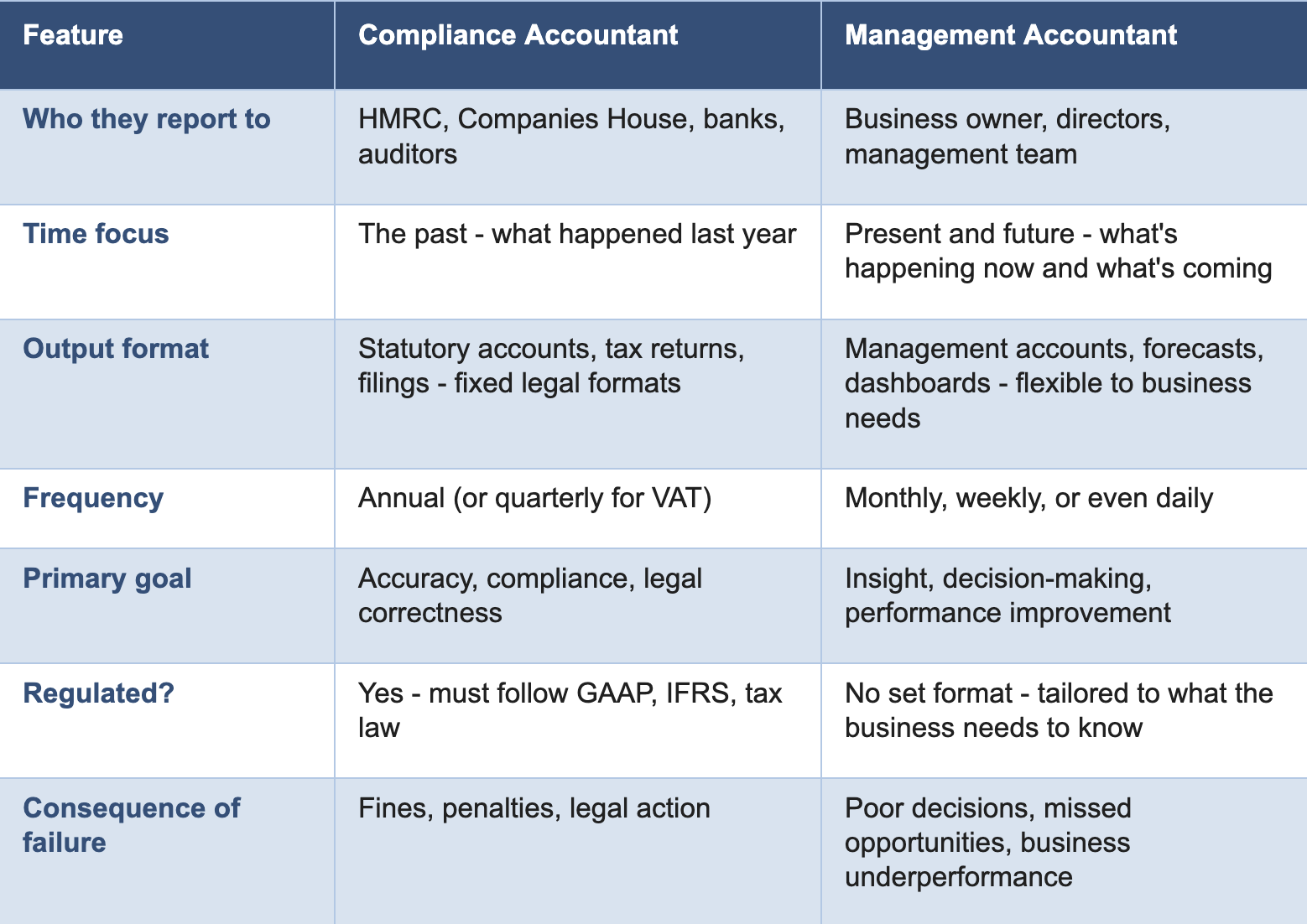
The key differences – side by side
All accountants love a table, here’s ours.
So how do these different accountants work together?
In many businesses, especially smaller ones, these roles are either combined into one person or handled by different professionals who must collaborate closely. Understanding how they connect and why they need to connect is crucial for any business owner.
The Data Flow: Management Accounts Feed Compliance
The management accountant and their team are the ones maintaining the day-to-day bookkeeping and financial records throughout the year. This ongoing, accurate record-keeping is precisely what the compliance accountant needs to prepare the year-end statutory accounts and tax returns. Poor management accounting creates chaos at year-end compliance time.
Accurate and reliable records help the compliance accountant have confidence in the business and makes their job easier.
Tax planning: An opportunity spotted by the Management Accountant, confirmed and actioned by Compliance.
Because management accountants track financial performance throughout the year, they are often the first to spot tax planning opportunities. They can then flag to the compliance accountant or tax adviser.
Cash Flow: The Management Accountant Prevents the Crisis
One of the most common reasons small businesses fail, is running out of cash. We see this sometimes, even when they are technically profitable. The management accountant's cash flow forecasting role is essential here, and it directly supports the business's ability to meet its compliance obligations.
Business Decisions: The Management Accountant Informs, the Compliance Accountant Validates
When a business owner wants to make a significant decision like taking on a new member of staff, purchasing a vehicle, moving to new premises, the management accountant models the financial impact. The compliance accountant ensures the tax and legal treatment is handled correctly.
Two Roles, One Goal
Compliance accounting and management accounting are not in competition. They are complementary. Every business that wants to grow sustainably needs both.
The compliance accountant ensures the business is legally sound, tax-efficient, and trusted by external stakeholders. The management accountant ensures the business is making smart decisions, understanding its own performance with good record keeping and reporting, and heading in the right direction.
For the business owner, the relationship between the two is powerful: the management accountant generates the clean, meaningful data and forward-looking insight; the compliance accountant converts that into legally compliant filings and ensures the taxman is paid the right amount.
The Bottom Line for Business Owners from Porterdale
If you only have a compliance accountant, you are flying blind. You know the rules are being followed, but you don't know if your business is actually healthy or heading in the right direction.
If you only have a management accountant, you might be making great decisions but filing incorrect tax returns and risking serious penalties.
The most successful businesses invest in both and make sure the two talk to each other.
If you’re not quite at the stage to employ a management accountant internally, you can use a fractional option. This is where we fit in at Porterdale, acting as your own management accountant and fulfilling the role as if we were on your payroll. Contact us today to chat things over.
Words by Lindsey Owen
Header photo by holigil 27 on Unsplash