

Finance Director or Financial Controller: We Have Both, But Which One Do You Need?

Background
We’re a bit of a different set up here at Porterdale. You’ll see a lot of Fractional Finance Directors and CFOs out there, but not many Fractional Financial Controllers. We have both and believe that makes us a great partner for your business.
In plain English: a Financial Controller, (FC), keeps the numbers accurate and the books in order. A Finance Director, (FD), uses those numbers to help grow and steer the business.
Businesses are often ready for either or both at different stages. Let’s take this opportunity to explain the differences with the roles and how they both help your business.
The Finance Director – the big picture person
Think of your Finance Director as the person who sits alongside the CEO on the board and helps make the big calls. They’re not just tracking money. They’re thinking about where it should go, where it should come from, and how the financial side of the business needs to evolve over the next few years.
The FD is responsible for:
Setting the financial strategy. A proper three-year plan, not just next quarter’s budget.
Managing relationships with the bank, investors, and the rest of the board.
Making the call on big investments and any acquisition opportunities.
Making sure the business is funded in the right way, at the right cost.
Presenting results and forecasts to the rest of the board.
Leading and developing the whole finance team.
Liaising with external compliance accountants on structure and strategy.
The Financial Controller – the accuracy and compliance person
The Financial Controller makes sure everything that’s already happened is properly recorded, reported, and in order. They’re not setting strategy. They’re making sure the foundations are solid. Think of them as the person who keeps the engine running cleanly, so the Finance Director has reliable numbers to work with.Overseeing the business finance team and ensuring accurate record keeping and processes.
The Financial Controller looks after:
Getting the monthly management accounts out on time and making sure they’re right.
Keeping the business compliant with tax rules, accounting standards, and statutory filings.
Managing the annual accounts submission and being the main point of contact for external compliance accountants.
Running proper financial controls so money can’t go missing or be misused.
Overseeing invoicing, payroll, expenses, and day-to-day cash management.
Producing the reports and data that the FD and senior management rely on.
Managing the finance team’s day-to-day operations.
A Handy Table – at a glance comparison
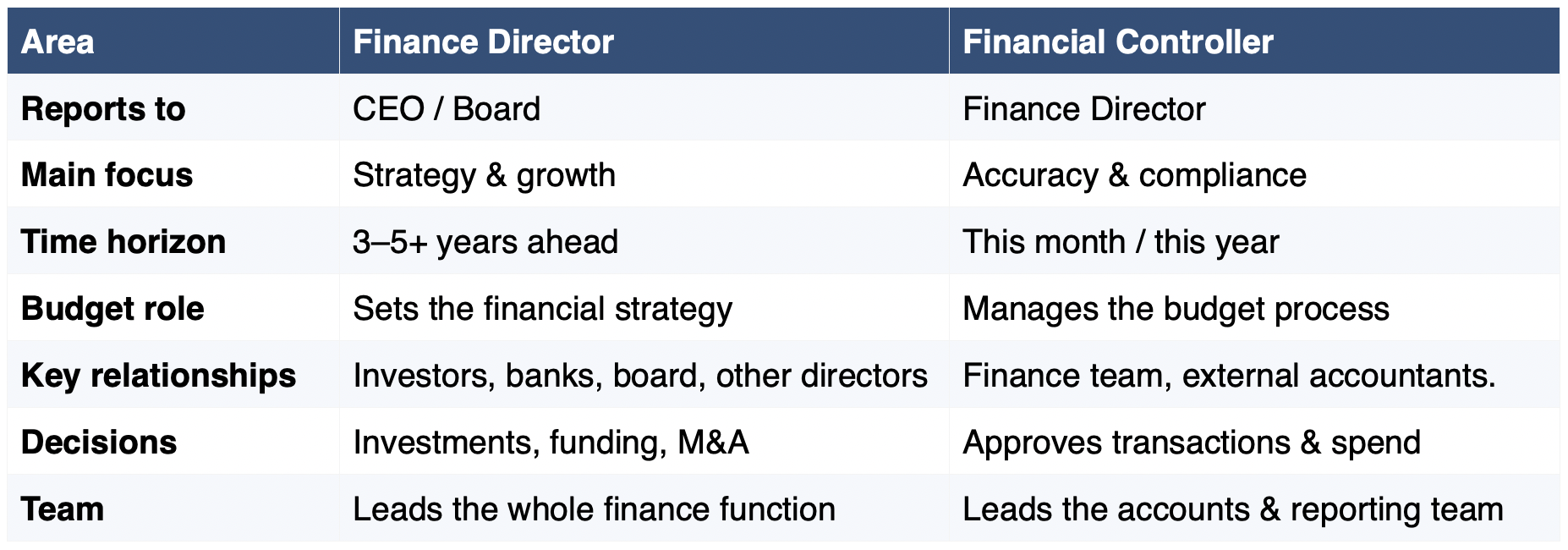
How do the roles play out in practice?
They think about time differently
Your Finance Director is always thinking ahead. What does the business look like in three years? How do we fund that expansion? What happens to our margins if interest rates stay high? Their job is to be forward-looking.The Data Flow: Management Accounts Feed Compliance
Your Financial Controller is focused on the here and now (and the recent past). Did we close the month correctly? Are we compliant? Did the reporting give the information that was needed?
Both views matter enormously - you just need different people owning each one.
They talk to different people
The Finance Director will spend time with the board, the bank, and external parties. Those conversations are high-stakes and need someone who can hold their own commercially, tell a clear story with numbers, and push back when needed.
The Financial Controller’s world is different. Good relationships with the compliance accountants and the wider team of the business are vital for this role. Just as important, but it calls for a different skill set. Precision and preparation matter more than big-picture narrative.
Their backgrounds tend to be different too
Financial Controllers usually come up through technical accounting; they’ve got their hands dirty doing the groundwork and they’ve built deep expertise in how the numbers work.
Finance Directors often have a broader base: definitely some commercial experience, maybe a stretch in accounting practice or audit, possibly time in general management.
How do you know which one you need?
You probably need a Financial Controller if…
Your monthly numbers are often late, wrong, or hard to trust.
The business is growing fast, and the finance team is struggling to keep pace.
You’re not confident your financial controls would catch a problem if one arose.
VAT returns, payroll, or statutory deadlines feel like a constant scramble.
You probably need a Finance Director if…
You’re thinking about raising money, selling the business, or making an acquisition.
Big financial decisions are being made without a proper commercial framework behind them.
You’re dealing with investors or a bank and don’t have a senior finance person to lead those conversations.
You’re making important calls on gut feel because the analysis isn’t there to back them up.
Porterdale’s Comments
These two roles aren’t in competition with each other. They’re genuinely complementary. A business with a great Financial Controller but no Finance Director has solid foundations but no navigator. One with a strong Finance Director but an inexperienced finance team is building strategy on unreliable ground.
You don’t always need both at the same time, and the right answer depends on where your business is right now. But being clear about the difference, and deliberate about which role you actually need, is the kind of decision that pays off for years to come.
And the best thing about Porterdale providing the services related to these roles on a fractional basis is that you don’t need to add to your headcount to start on the journey. We’ve done the roles in businesses, and we can pass that experience and expertise on to you.
Get in touch with us today to see who you’re ready for.
Words by Lindsey Owen
Header photo by Anastasia Petrova